
Liquid Crystal-driven Superspreading of Polymer Droplets at the Air Water Interface
Citation
Yuanzhu Song, Xingchao Chen, Yanjun Liu* and Peiyi Wu*. Liquid Crystal-driven Superspreading of Polymer Droplets at the Air Water Interface. Chin. J. Polym. Sci. 2026, ASAP.
Abstract
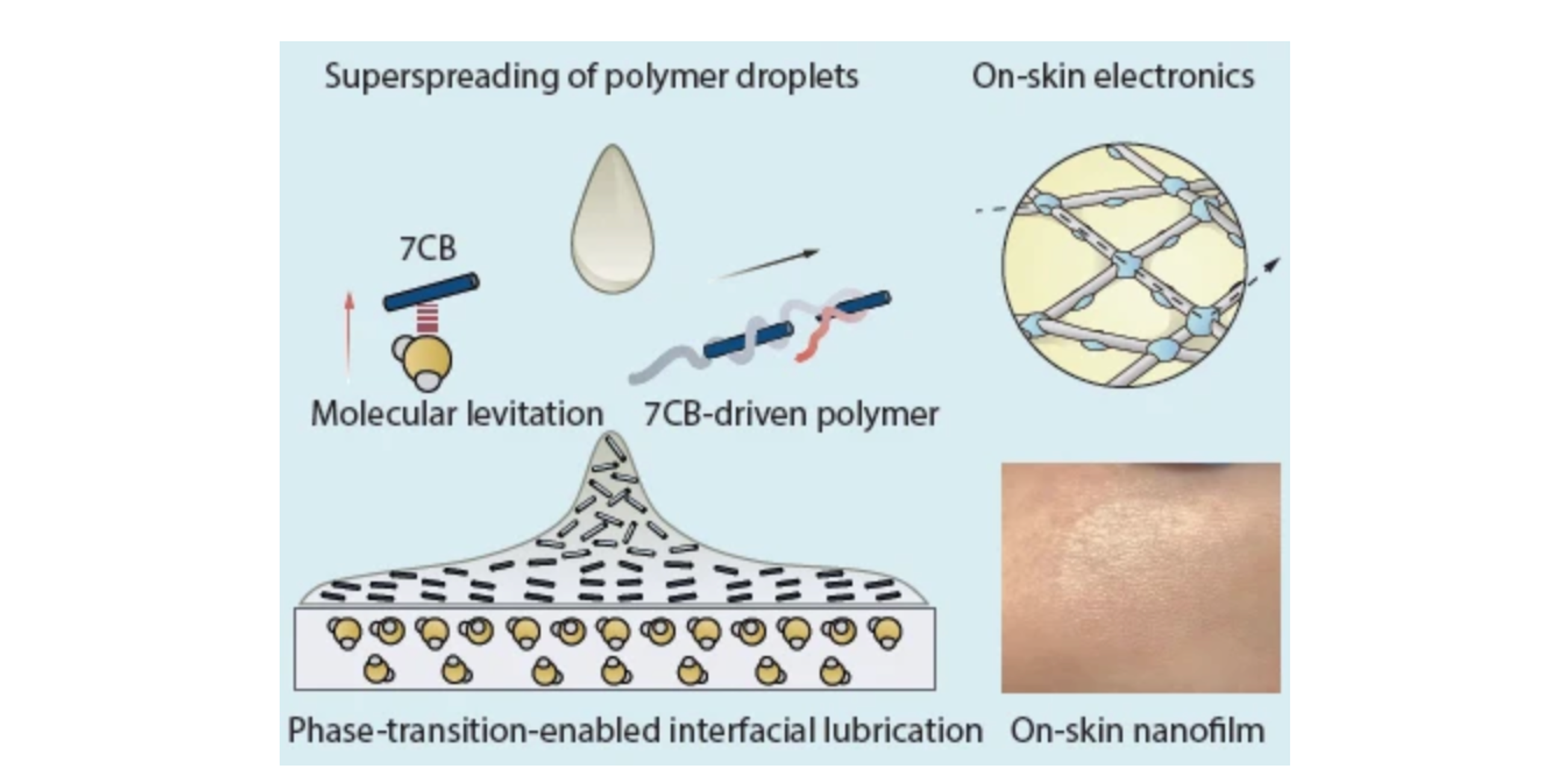
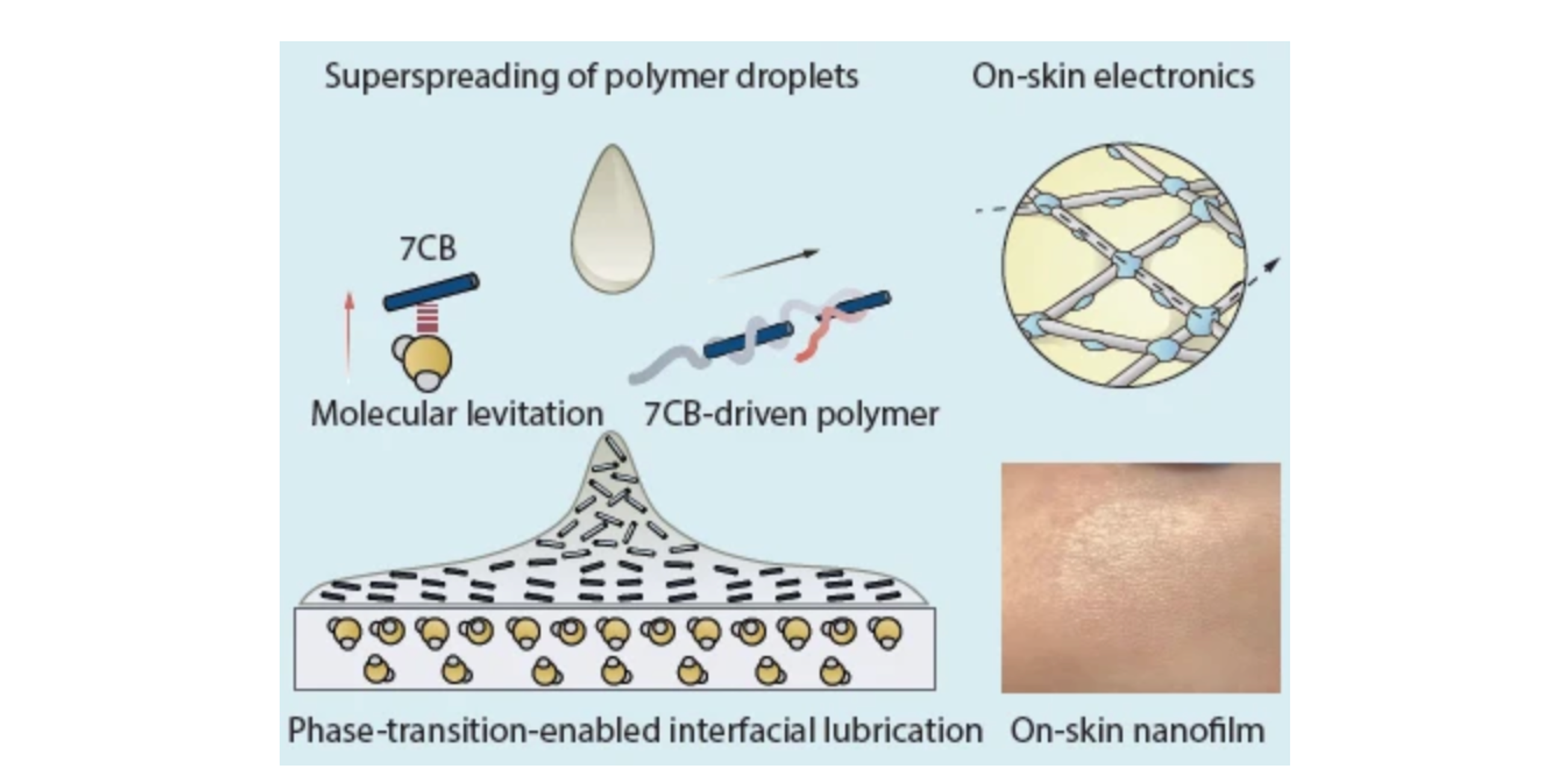
Ultrathin polymer films are difficult to fabricate over large areas and transfer without damage. Spreading polymer droplets on water offers an atomically flat and releasable substrate, but the attainable area is limited by interfacial friction and tension gradient difference. Here, we show that interfacial resistance, rather than tension difference alone, dictates the spreading limit. By introducing a hydrophobic liquid crystal (4-cyano-4′-heptylbiphenyl, 7CB), we uncover a superspreading phenomenon in which polymer droplets rapidly expand into large-area ultrathin films on aqueous salt solutions. This behavior is enabled by a phase-transition-enabled interfacial lubrication mechanism. During spreading, 7CB reaches a low-mobility nematic liquid-crystalline state and becomes enriched on the organic side of the solvent-water interface, forming a dynamically generated lubricating region that reduces resistance to rapid liquid-liquid spreading. Low-field nuclear magnetic resonance (NMR) measurements reveal a sharp transition in molecular mobility, directly linking the phase state of 7CB to interfacial resistance reduction. This strategy is universal across polymers with diverse mechanical properties and enables the fabrication of transferable, nanometer-thick films with integrated functionalities. These findings redefine the role of liquid-liquid interfaces in spreading dynamics and provide a general framework for designing near-frictionless interfacial transport processes.