
Synergistic Spring-entanglement Network Design of High-modulus and Low-hysteresis Ionic Elastomers...
Citation
Ting Cui, Jingming Cai, Cunyi Li, Zhuoyue Lei* and Peiyi Wu*. Synergistic Spring-entanglement Network Design of High-modulus and Low-hysteresis Ionic Elastomers for High-fidelity Sensing. Chin. J. Polym. Sci. 2026, ASAP.
Abstract
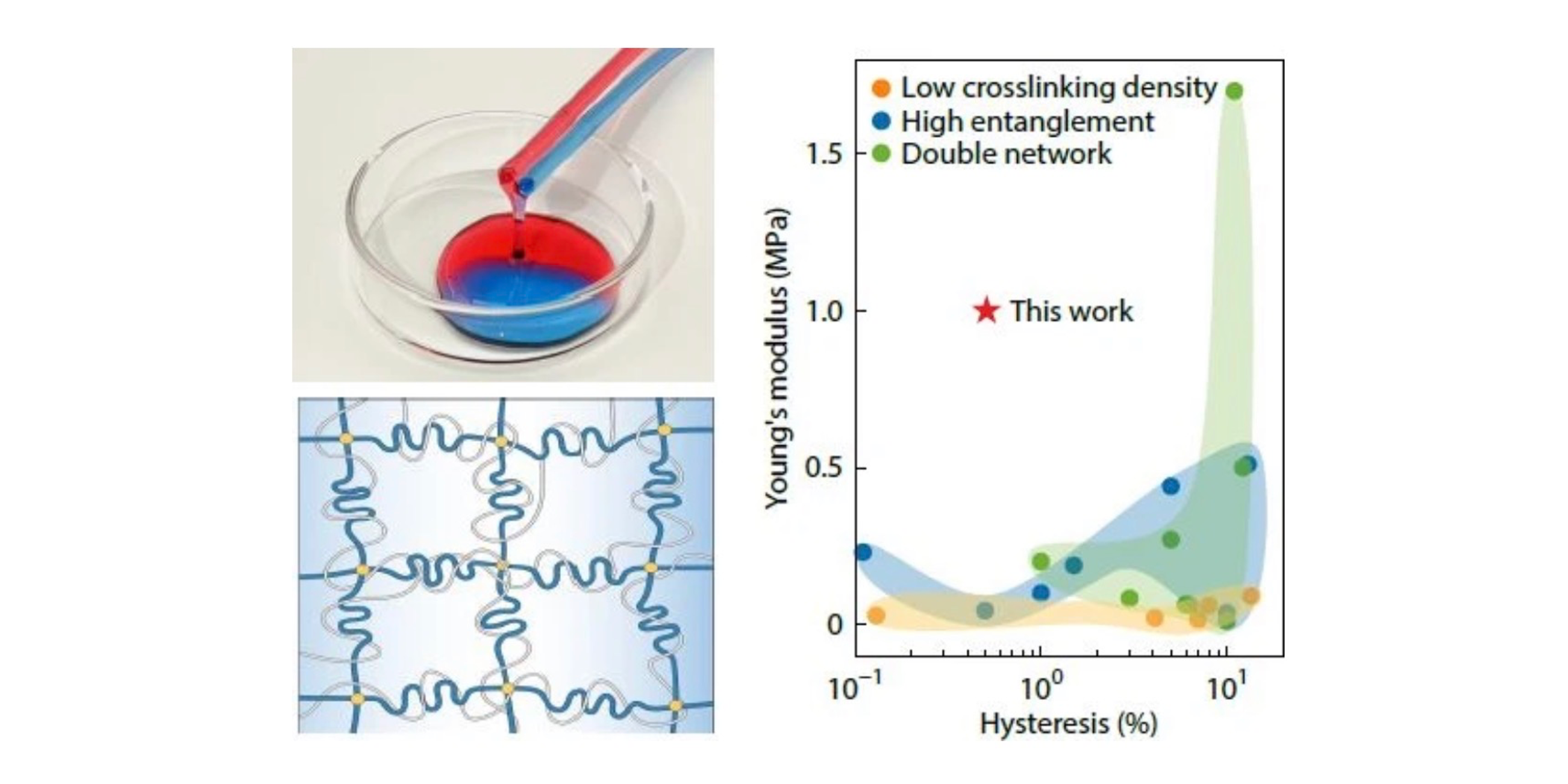
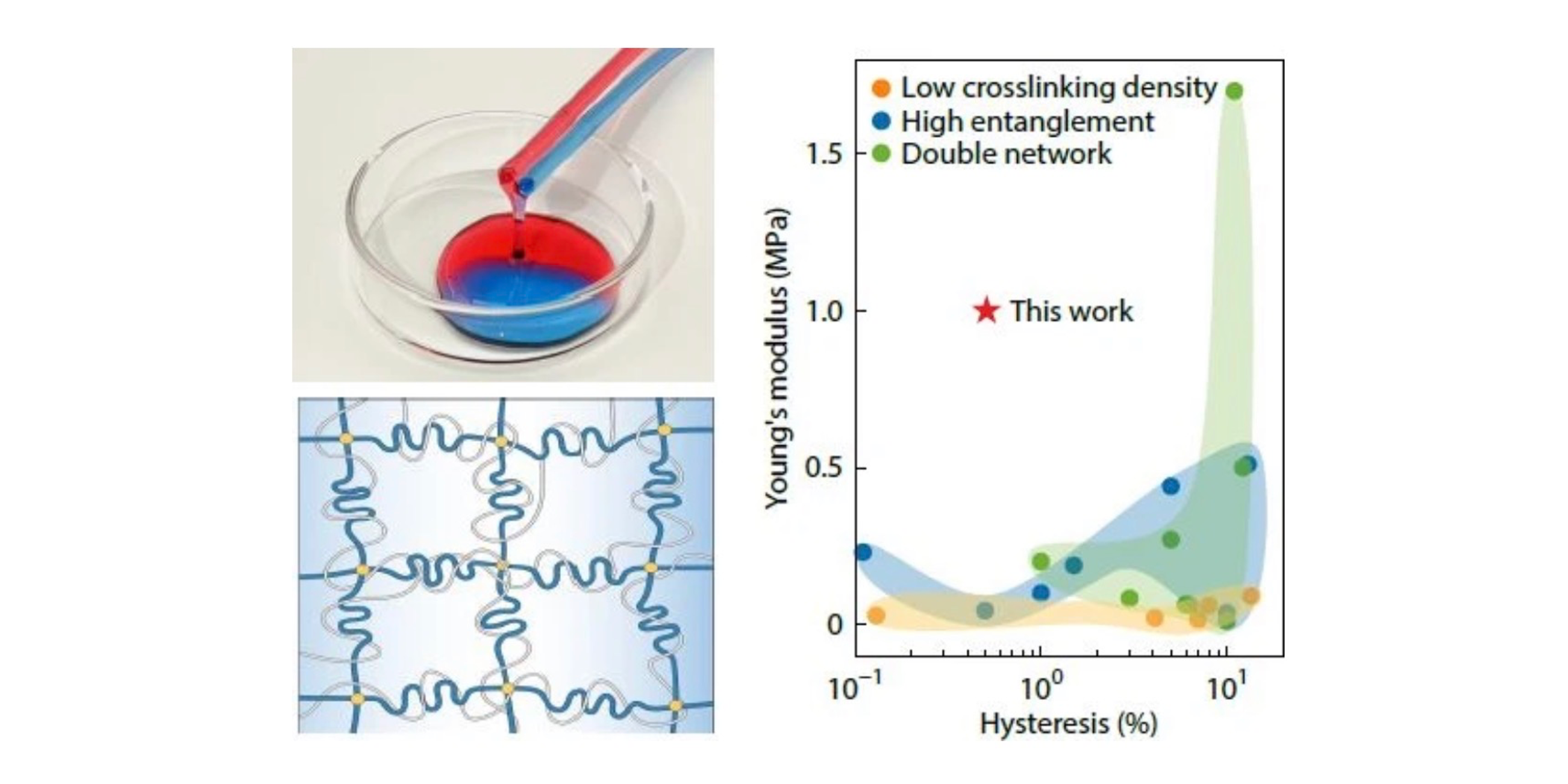
The development of high-performance ionotronics is currently hindered by the fundamental trade-off between mechanical robustness (high modulus and toughness) and functional reliability (low hysteresis and high elasticity). Conventional toughening mechanisms that rely on sacrificial bonds inevitably introduce significant energy dissipation and irreversible creep, leading to fatal signal drifts in long-term applications. Herein, we report a synergistic spring-entanglement network that achieves simultaneous optimization of the modulus, recovery, and extensibility via topological modulation. By utilizing a click-chemistry-derived covalent framework as a stiff athermal spring, the elastomer achieved a skin-like modulus (approximately 1 MPa) and near-zero hysteresis (<0.51%). The strategic integration of ultra-high-molecular-weight polymer entanglements introduces topological constraints that function as non-dissipative stress delocalisers, facilitating a fracture strain of 142% without compromising the instantaneous restorative force. This architecture maintains low hysteresis and high elasticity over 10000 cycles, ensuring impeccable signal fidelity and negligible baseline drift in multimodal sensing. This synergistic topological design provides a robust foundation for reliably stable human-machine interfaces and precision ionotronics.